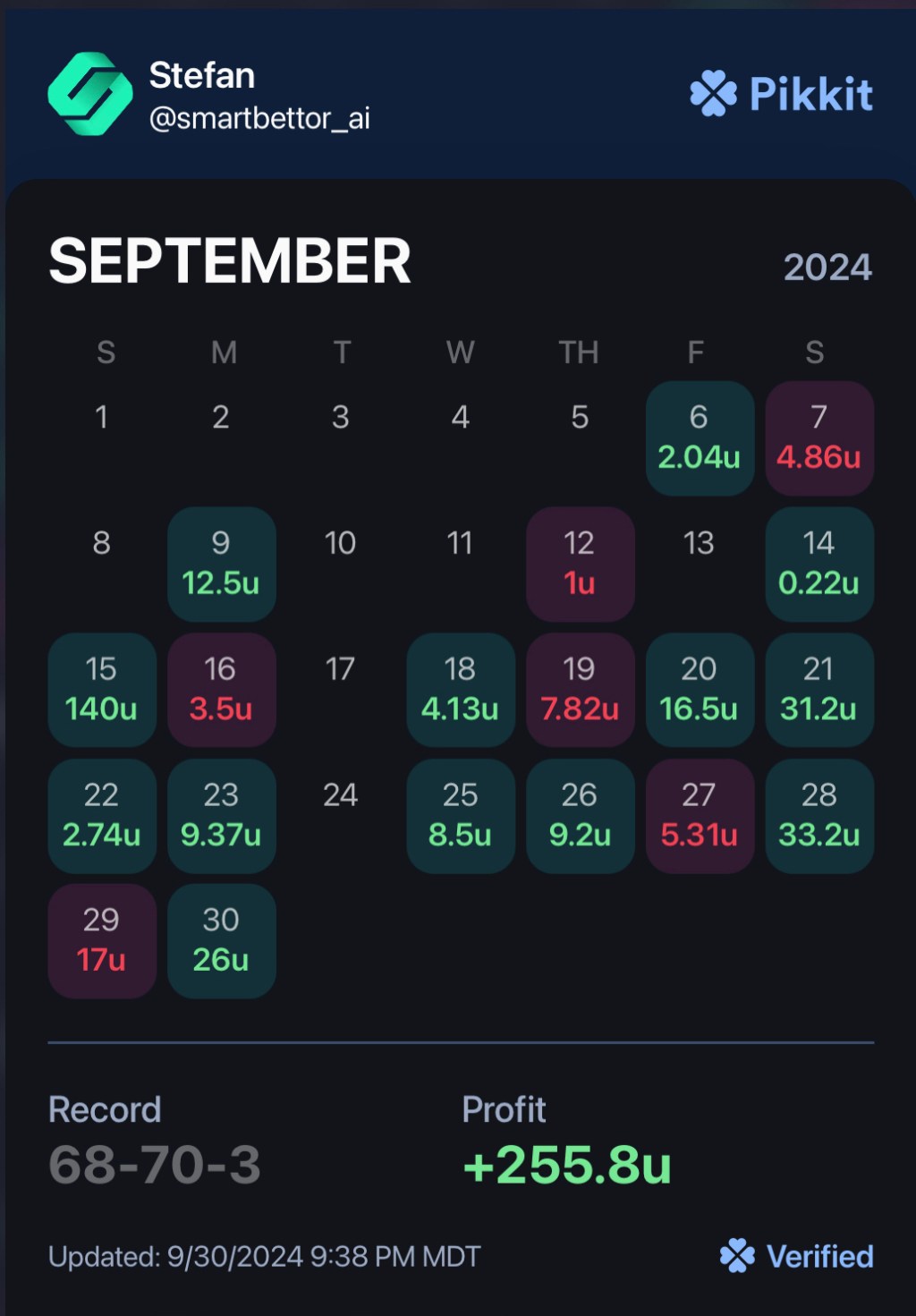
At SmartBettor, our goal is simple: to help you bet smarter and, ultimately, win more often.
Sports betting isn’t just about luck or picking the right team. In fact, successful betting requires a strategy built on math and probability. One of the most important concepts behind this strategy is Expected Value (EV). If you’re serious about improving your betting results and becoming profitable over the long term, understanding EV is crucial.
What is Expected Value?
Expected Value is a mathematical concept that estimates the average outcome of a bet over many repetitions. It helps you assess whether a bet, based on its odds and probabilities, is expected to generate a profit or lead to losses in the long run, regardless of short-term fluctuations
Imagine you’re betting on a coin flip. There’s a 50/50 chance it will land on heads, and a 50/50 chance it will land on tails. If you bet $100 on heads at even odds (1:1 or +100), you would win $100 for heads and lose $100 for tails. The expected value of that bet is zero. Over thousands of coin flips, you would win as often as you lose, resulting in zero profit.
However, if a sportsbook pays you only $95 for winning, while you still lose $100 on a loss, you’re in negative EV territory. Even with a 50/50 outcome, you’d lose money over time because the payout ($95) is less than the amount you stand to lose ($100), creating a negative long-term expectation. This is the reality of most bets placed by casual bettors—negative EV due to built-in house edges, known as “vig” or “juice.”
Let’s look at an example of a positive EV bet using the same coin flip scenario. Imagine a sportsbook offers you better-than-even odds (+105) on heads. When you place a $100 bet on heads, instead of winning $100 for heads, you win $105, while you still lose $100 if the coin lands on tails.
With the outcome of the coin flip still being 50/50, this bet offers a positive Expected Value. Here’s why:
- If you win, you get $105.
- If you lose, you lose $100.
Over the long run, for every 100 coin flips, you’d expect to win 50 times and lose 50 times. The math would look like this:
- Total amount wagered: $10,000 (100 bets x $100)
- Winnings from 50 wins: $5,250 (50 wins x $105)
- Losses from 50 losses: $5,000 (50 losses x $100)
Net result: $5,250 – $5,000 = +$250. This results in a 2.5% positive Expected Value ($250 profit / $10,000 wagered.)
This means that over time, you would expect to make $250 for every 100 bets you place. In this scenario, the payout exceeds the amount you risk, leading to a positive Expected Value and putting you in a position to profit over the long term.
Why Expected Value Matters
Expected Value is more than just a mathematical concept; it’s a framework for making smarter bets. It shifts your focus away from simply predicting winners and onto identifying bets that are mathematically profitable over time.
Finding positive EV bets—where the payout is greater than the implied probability of the outcome—means you’re betting with an edge. Even if you don’t win every bet, positive EV ensures that, in the long run, you come out ahead. On the flip side, negative EV bets are a losing proposition, no matter how confident you feel about the outcome. Over time, they will steadily chip away at your bankroll.
Building a Profitable Betting Strategy
To consistently profit from sports betting, you need to prioritize value over immediate results. Here’s how Expected Value plays into a winning strategy:
- Hunt for Positive EV Bets: The odds offered by the sportsbook are sometimes better than they should be based on the likelihood of the outcome. This can happen when bookmakers misprice odds or when the public overvalues one side of a bet.
- Steer Clear of Negative EV Bets: It’s tempting to go with your gut, especially when you’re confident in a team or player. But if the odds are stacked against you, no amount of confidence can change the fact that you’re taking a losing bet in the long run.
- Think in Terms of Probability, Not Certainty: In sports betting, nothing is guaranteed. Even when you find a positive EV bet, there’s a chance it won’t win. The key is consistency—placing enough positive EV bets over time will lead to profitability.
At SmartBettor, we provide tools to help you spot these positive EV opportunities. We even take it a step further with our AI + EV model by leveraging machine learning to identify only the best +EV bets to take. On an average day, there are hundreds — if not thousands — of +EV betting opportunities, which makes it nearly impossible to place all of them. This causes a problem: how do you know which +EV bets to take? By streamlining the process and recommending only the highest quality +EV bets, we take the guesswork out of EV betting and put you in a stronger position to succeed.
The Bigger Picture
Understanding and applying the concept of Expected Value can transform how you approach sports betting. It’s not just about picking winners—it’s about making bets that have the potential to be profitable over time. This long-term perspective is what separates casual bettors from those who are consistently profitable.
The bottom line is this: If you want to be a winning sports bettor, focus on the Expected Value of your bets. Positive EV bets lead to long-term success, while negative EV bets drain your bankroll. By making smarter, value-driven decisions, you can turn the odds in your favor.
 learn.smartbettor.ai
Leave a comment